
About Family Trusts
Understanding Family Trusts in South Africa
Understanding Family Trusts
A plain-English guide by Hoosen Agjee — drawn from his book The Use of Family Trusts: From the Bedroom to the Boardroom and Beyond — for anyone who has never dealt with a trust before.
What Is a Family Trust?
Think of a Trust as a safe, separate "box" for your assets — a house, a business, an investment — that you no longer own personally, but that is managed for the benefit of the people you love.
In legal terms, a Trust is an agreement in which one person (the Donor) hands over property to a small group of people (the Trustees) to look after and manage — not for themselves, but for the benefit of others (the Beneficiaries) — all according to a written rulebook called the trust deed.
That's really all a Trust is: a set of assets, owned by no one person, controlled by trusted managers, for the benefit of your family. It is registered with the Master of the High Court and, once formed, becomes its own legal entity — completely separate from you, your Trustees, and your Beneficiaries.
A Trust does not disappear when you die, when a Trustee resigns, or when a Beneficiary passes away. Like a company, it simply continues — which is exactly why it is such a powerful tool for protecting a family's wealth across generations.
The Three Parties to a Trust
Every Trust has exactly three roles. Understanding them is the key to understanding everything else about a Trust.
Donor / Founder
The person whose assets are placed into the Trust. They set the vision — who should benefit, and on what terms.
Trustees
The people who control and manage the Trust's assets — the property, business interests, and bank accounts. Much like directors run a company.
Beneficiaries
Your family — those entitled to receive the income and/or capital of the Trust. Much like shareholders receive dividends from a company.
"Would I lose control of my assets by placing them in a Trust?" — Yes, you legally give up ownership. But by appointing yourself as one of the Trustees, you continue to help manage and control those very assets alongside your co-Trustees — and your family, as Beneficiaries, keeps enjoying the benefits.
From the Book — Abie & Ebie
Abie transferred most of his assets into a Trust, remaining a Trustee alongside his spouse and a family friend — his family carried on enjoying the income. Ebie chose instead to transfer assets directly into his children's names. Years later, Ebie's son ran into financial trouble and lost a property that had been registered in his own name. Had it been held in a Trust, it would have been protected.
How a Trust Works
Forming a Trust is a straightforward, well-defined legal process:
The Donor and Trustees sign a trust deed — the Trust's rulebook.
The signed deed is lodged with the Master of the High Court.
The Master issues Letters of Authority — the Trust's "birth certificate".
Only now can the Trustees open a bank account and act on the Trust's behalf.
Once formed, the Trust owns its assets in its own right — separate from the Donor, the Trustees, and the Beneficiaries personally. It has its own bank account, is registered as a taxpayer with SARS, and its Trustees keep proper books of account, just as a company would.
A Trust vs a Company — What's the Difference?
People often confuse the two because the roles look similar. Here is where they really differ:
| Feature | Company | Trust |
|---|---|---|
| Who benefits | Only shareholders — must have paid for their shares | Any Beneficiary named in the deed — even one who contributed nothing at all |
| Starting capital | Shareholders must contribute capital to share in profits | No start-up capital required from Beneficiaries |
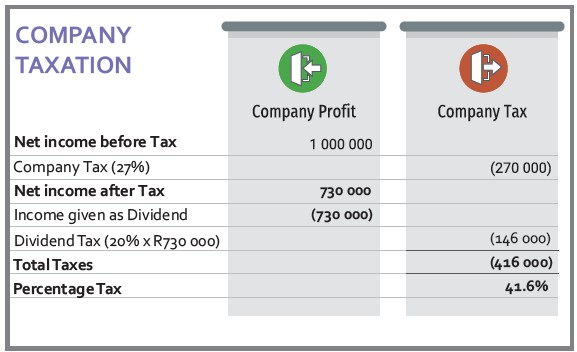
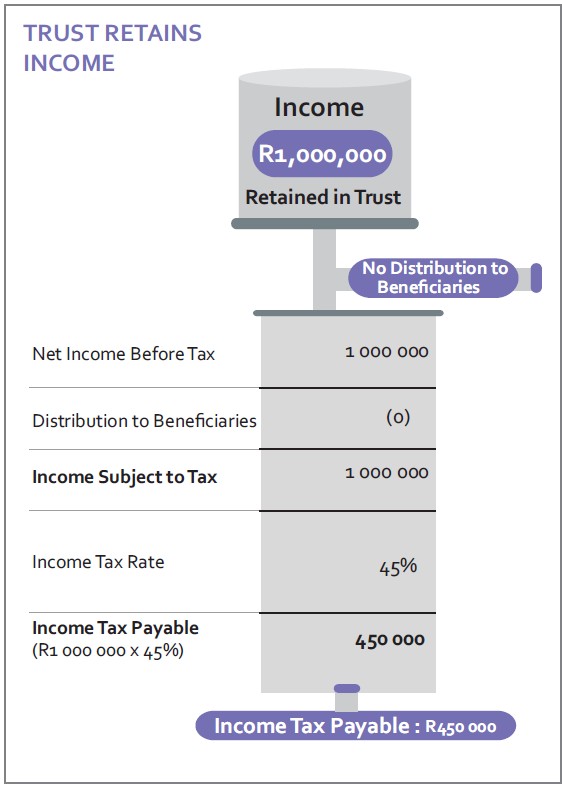
| Tax on income kept in | 27% company tax, then 20% dividend tax when paid out — 41.6% effective | 45% if retained — but can be avoided by distributing to family members at their own, often lower, tax rate |
| Owing money to it | A director's loan is taxed as a dividend if interest isn't charged | A Beneficiary can owe the Trust money interest-free with no such penalty |
| Continuity | Continues regardless of shareholder changes | Continues regardless of the death of the Donor, a Trustee, or a Beneficiary |
Don't just take our word for the 41.6% vs 45% comparison — here's how the book itself works the numbers:
The Flow-Through Concept
This is the single feature that sets a Trust apart from every other structure. In a company, a partnership, or a sole proprietorship, only the people who put money or effort in are allowed to share in the profit.
A Trust breaks that rule. The Trustees can pass income and capital straight through to a Beneficiary who has contributed nothing — not money, not labour, nothing. Even a baby who is a named Beneficiary can receive a distribution.
| Structure | Who can receive profit | Who bears the loss |
|---|---|---|
| Company | Shareholders only, in proportion to shares held | Losses stay in the company |
| Partnership | Partners only, per the partnership agreement | Losses borne by the partners |
| Sole Proprietor | The owner only | Losses borne by the owner |
| Trust | Any named Beneficiary — no contribution required | Losses remain in the Trust |
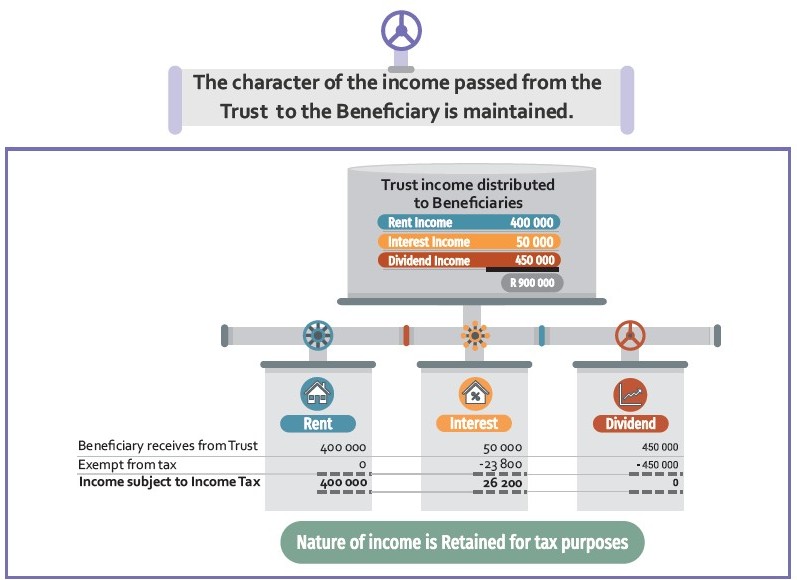
There's an added benefit: when income flows through a Trust to a Beneficiary, it keeps its original character. Rental income is still taxed as rental income; interest is still taxed as interest — passed on exactly as it was earned, in the hands of the person best placed to be taxed on it at the lowest rate.
Protecting What Matters Most
Because a Trust owns its assets separately from any individual, those assets are shielded from the very things that most often threaten a family's wealth.
Protecting the Beneficiaries Themselves
A Beneficiary cannot demand that Trustees hand assets over on request. This shields a spendthrift family member — or one going through a difficult patch — from squandering what should sustain the whole family.
Protection from Creditors
If a Beneficiary becomes insolvent, creditors cannot touch the Trust's assets — only what the Trust happens to owe that Beneficiary personally. The house, the business, the investment stays safe.
Protection in the Event of Divorce
Assets correctly held in a Trust generally fall outside a divorced spouse's claim, and a well-drafted deed prevents a spouse married in community of property from inheriting half of a Beneficiary's Trust loan account.
Protection of Minor Children
Funds due to a child are held safely by the Trustees until the child comes of age — instead of sitting in the state's low-yielding Guardian's Fund, out of reach of a surviving parent or guardian.
From the Book — Dr A's House
Dr A bought his house through a Trust. When a failed business venture left him insolvent and the Sheriff came to attach his assets, the house — worth R1,000,000 at the time — could not be touched. It belonged to the Trust, not to him personally.
Estate Duty & Tax Efficiency
Once the essentials of protection are understood, it's worth knowing that a Trust also carries real tax advantages — though this should never be the only reason to form one.
Assets owned by the Trust never form part of your personal estate, so they escape Estate Duty entirely when you pass away — only what the Trust happens to owe you is included.
Income can be distributed across several family members, each taxed at their own — usually lower — personal rate, instead of piling up at one high rate.
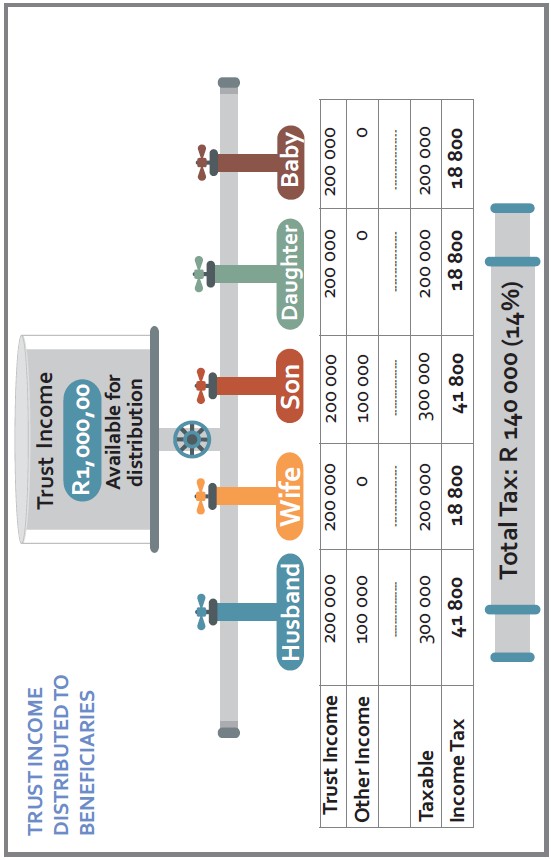
Split across five family members instead of landing on one high earner, that R1,000,000 attracts only R140,000 of tax in total — 14%, instead of climbing into a much higher personal tax bracket.
From the Book — Abie's R1.8 Million Saving
Abie put a property worth R1,000,000 into his Trust. By the time of his death, that property had grown to R10,000,000 — but because it belonged to the Trust and not to him, his estate only paid Estate Duty on the R1,000,000 loan the Trust owed him: R200,000, instead of R2,000,000. A saving of R1.8 million, simply by planning ahead.
Ready to Protect Your Family's Future?
Every family's circumstances are different. Hoosen Agjee has spent decades drafting and administering trusts across South Africa — let's talk about what a Trust could do for yours.
Get in Touch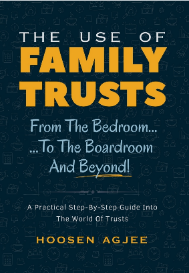
Related Publication
The Use of Family Trusts: From the Bedroom to the Boardroom and Beyond by Hoosen Agjee — an accessible guide to understanding family trusts in South Africa, covering formation, uses, tax implications, and strategic benefits for personal and business wealth planning.
Read Review & OrderGet your copy for R250 — scan to order